

Ghost Stories Difficulty Levels Explained: Which Should You Start On?
Initiate. Student. Veteran. Master.
Some links below are Amazon affiliate links — as an Amazon Associate, King Panda Games earns from qualifying purchases at no extra cost to you. Full disclosure.
Those are the four difficulty levels in Ghost Stories, and the gap between the bottom and the top is enormous. The base game doesn’t make it obvious which one to start on, and the rulebook doesn’t spend much time explaining what each level actually changes. So groups pick the middle option, get destroyed, and assume the game is broken.
It’s not broken. You just started on the wrong level.
This guide explains what changes at each difficulty, what you can expect at each one, and exactly where a new group should start — so you spend your first few sessions actually learning the game instead of watching it collapse.
If you haven’t read our full Ghost Stories review yet, start there for the complete breakdown of how the game works. This guide assumes you know the basics.
How Ghost Stories Difficulty Works
Ghost Stories difficulty is controlled entirely by the ghost deck. You start with a base set of ghost cards that are present at every level. Then you add in increasingly punishing cards from higher tiers.
The genius of this system is that the *type* of game doesn’t change — you’re always doing the same thing. What changes is the frequency and severity of the bad situations the deck creates. At Initiate, the deck is manageable enough to let you make mistakes and recover. At Master, the deck is specifically designed to punish every mistake immediately.
There are no rule changes between levels. No new mechanics. Just harder cards.
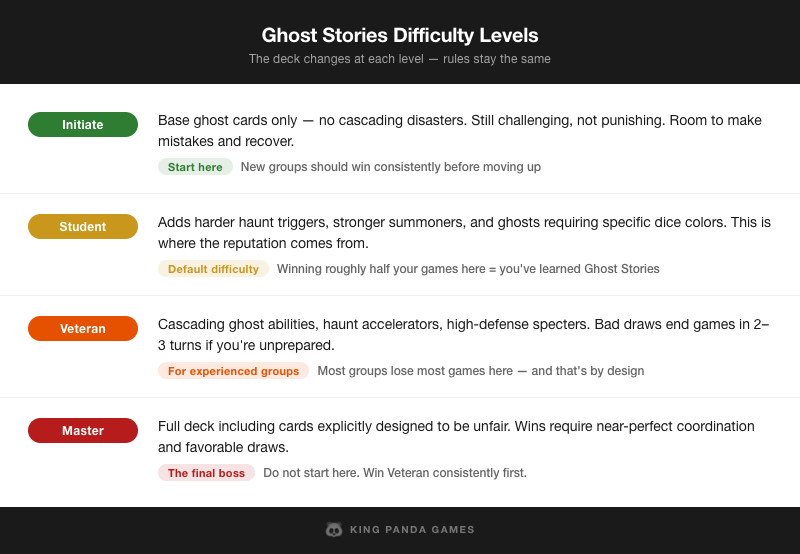
Initiate: Where Every New Group Should Start
Initiate uses only the base ghost cards — the least punishing, most learnable versions. It still has:
- Ghosts that haunt village tiles
- Ghosts that curse monks
- Ghosts that summon additional specters
- The full Wu-Feng encounter at the end
What Initiate doesn’t have is the ghost cards specifically designed to create cascading disasters. The summoner ghost that spawns two ghosts on appearance. The haunt-spreader that corrupts adjacent tiles. The wu-feng accelerator that moves his card earlier in the deck.
Starting here isn’t “easy mode.” We’ve lost on Initiate. We’ve lost on Initiate when we knew what we were doing. It’s a fully functional, genuinely challenging version of Ghost Stories. What it isn’t is a version of Ghost Stories designed to punish players who are still learning what the ghost cards do.
What to expect: You’ll lose your first few games while you learn the ghost abilities. By games three or four, you’ll start seeing the strategic picture. By games six to eight, you should be winning Initiate consistently. When you win three games in a row on Initiate without it feeling like a close call, you’re ready for Student.
Student: The Default Experience
Student adds a set of intermediate ghost cards to the base deck. These cards are more punishing than the Initiate pool but not designed to end the game in two turns the way Veteran cards can.
The meaningful additions at Student:
- More haunt triggers. Ghosts that haunt tiles more aggressively, giving you less time to respond before you start losing village capabilities.
- Stronger summoners. Summoner ghosts that spawn tougher specters, creating chain reactions that require coordinated responses.
- Harder defensive ghosts. Cards that require specific dice colors or conditions to defeat, meaning you can’t just bludgeon them with whatever you have.
Student is the level most published reviews assume when they say Ghost Stories is hard. It’s where the game earns its reputation. Groups that have cleared Initiate consistently will find Student a genuine step up — not overwhelming, but noticeably less forgiving.
What to expect: Even experienced players lose at Student. Winning here requires the five principles from our strategy guide applied consistently, good communication, and some luck. When you’re winning Student games about half the time, you’ve really learned Ghost Stories.
Veteran: For Groups Who’ve Mastered the Game
Veteran adds the nastiest of the non-final ghost cards. These are the cards that create board states so bad they end games in two or three turns if you’re not prepared.
At Veteran, you’ll encounter:
- Ghosts with cascading abilities that trigger chain reactions across multiple lanes.
- High-defense specters that require matching several specific colors simultaneously — impossible without strong Tao token management.
- Haunt accelerators that corrupt village tiles faster than you can respond if you’re not actively protecting them.
Veteran is for groups that have played dozens of Ghost Stories games and want a challenge worthy of their experience. We’ve played at Veteran a handful of times and won perhaps once. It’s a brutal experience even with strong coordination.
What to expect: Most groups will lose most games at Veteran. That’s intentional. The fun at this level is the rare, hard-fought win.
Master: The Final Boss of Difficulty
Master uses the full ghost deck including the most punishing cards in the game. These are cards that were explicitly designed to be unfair.
We’ll be honest: we haven’t won at Master. We know groups that have. They’ve played Ghost Stories for years and treat Master as a genuine achievement when they win it. The losses at this level can be so fast and so complete that they feel less like a game and more like a demonstration of how badly things can go.
What to expect: You will probably lose at Master. Multiple times. Possibly within ten minutes. The groups that win at Master are the ones who have internalized every ghost card’s behavior, play with near-perfect coordination, and still need good draws to pull it off.
Do not start here. Do not start here even if you’ve played cooperative games for years. Ghost Stories Master is not hard in the way other games are hard. It’s hard in a very specific, Ghost Stories way that only makes sense after you’ve put in significant time at lower levels.
The Honest Recommendation
Start on Initiate. Win it three times. Move to Student. Live at Student until you’re winning roughly half your games. Peek at Veteran when you’re curious whether you’ve actually mastered the game.
Most groups will find their home at Student. That’s where Ghost Stories is most fun — hard enough that wins mean something, manageable enough that you can see what you did wrong when you lose.
The difficulty system is one of the best things about this game because it means Ghost Stories can grow with your group. You’re not buying a game that gets stale after ten plays. You’re buying a game that gets harder as you get better.
That’s worth a lot.
Don’t own Ghost Stories yet? This guide assumes the base game.
Check Ghost Stories price on Amazon →
Frequently Asked Questions
What are the different difficulty levels in Ghost Stories?
Ghost Stories features four distinct difficulty levels: Initiate, Student, Veteran, and Master. These levels progressively introduce more punishing ghost cards into the deck, dramatically increasing the challenge without altering the core rules of the game.
Which difficulty level should new players start on in Ghost Stories?
New groups should absolutely start on Initiate difficulty, despite what the rulebook might imply. This level uses only the most learnable ghost cards, allowing you to grasp the game's strategies without being immediately overwhelmed by cascading disasters. It's still genuinely challenging, but it's designed for learning, not immediate defeat.
Is Ghost Stories an unfairly difficult or broken game?
No, Ghost Stories is definitely not broken, though it often feels that way to new players who start on the wrong difficulty. The game's brutal reputation usually stems from groups jumping into Student or Veteran levels too soon, which are designed to punish mistakes, not teach the ropes. Starting on Initiate provides a proper learning curve.
How does the difficulty actually change between levels in Ghost Stories?
The difficulty in Ghost Stories is entirely controlled by the ghost deck, not by changing any game rules or mechanics. Higher difficulty levels simply add increasingly punishing and complex ghost cards to the base deck, making bad situations more frequent and severe.
Is the Initiate difficulty level in Ghost Stories just "easy mode"?
Absolutely not; calling Initiate "easy mode" is a huge misconception. We've lost on Initiate even when we knew what we were doing, proving it's a fully functional and genuinely challenging version of Ghost Stories. It's specifically designed to let you learn without being instantly crushed, not to be a cakewalk.
When should a group move up from Initiate to Student difficulty in Ghost Stories?
You should only consider moving to Student difficulty once your group is consistently winning on Initiate. Specifically, aim for three consecutive wins on Initiate where it doesn't feel like a close call. This ensures you've mastered the strategic picture before facing the more punishing intermediate ghost cards.
What kind of ghost cards are included in the Initiate difficulty deck?
The Initiate deck includes only the base ghost cards, which are the least punishing versions designed for learning. You'll encounter ghosts that haunt tiles, curse monks, and summon specters, culminating in the full Wu-Feng encounter. Crucially, it omits the devastating summoners, haunt-spreaders, and Wu-Feng accelerators that create cascading disasters.