

Ghost Stories Monk Powers Guide: Which Color Should You Pick?
One of the first decisions you make in Ghost Stories is choosing your monk color. Red, blue, yellow, green — each one plays differently, and picking the wrong color for your playstyle (or failing to coordinate colors across your group) is one of the fastest ways to lose.
Some links below are Amazon affiliate links — as an Amazon Associate, King Panda Games earns from qualifying purchases at no extra cost to you. Full disclosure.
This guide breaks down all four monk powers, when each one shines, and — more importantly — how to use them together. Because in Ghost Stories, monk powers only reach their full potential as a coordinated team, not as individual characters.
If you’re still deciding whether Ghost Stories is worth learning, start with our full review. If you’re already in and want to start winning, read on.
The Red Monk: The Reliable Fighter
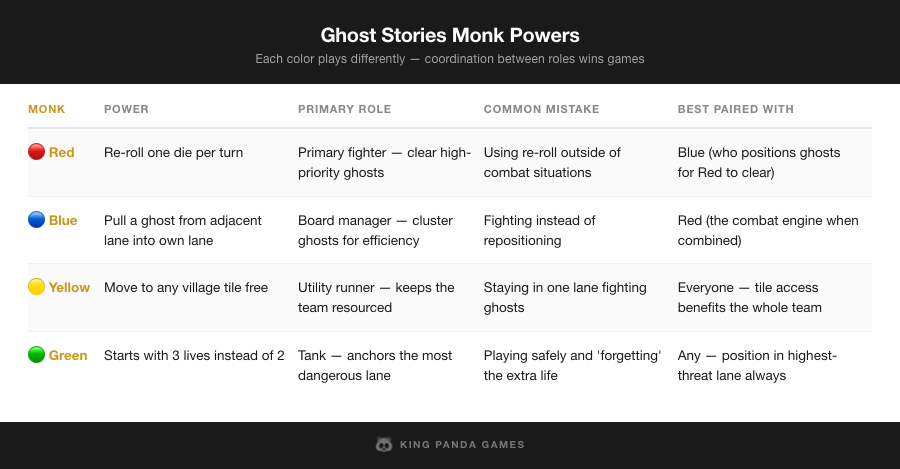
Power: Once per turn, re-roll any single die.
The red monk is the most straightforward of the four and often where newer players gravitate. A re-roll on demand is a consistent combat edge — it meaningfully increases the odds of winning fights, especially against ghosts that require hitting specific color combinations.
When to use it: The re-roll is best spent on fights you’re close to winning but missing one die result. If you rolled three of four required symbols, that re-roll often pushes you over. Using it when you’re missing two or three symbols is usually wasted — the math rarely saves you from that far back.
Common mistake: Using the re-roll every turn regardless of the strategic situation. The re-roll is a combat tool. If you’re spending your action on a village tile or passing tokens rather than fighting, the re-roll isn’t doing anything. Red monks should fight more than other monks specifically because their power only activates in combat.
Role in the group: Primary fighter. Position the red monk to clear high-priority ghosts, especially ones with punishing abilities that need to go away quickly. Don’t send them on tile-running errands when ghosts need to die.
The Blue Monk: The Strategic Wildcard
Power: Can move ghosts from adjacent lanes into their own lane.
The blue monk is the most misunderstood monk in the game — and the one that, when played correctly, has the biggest impact on group outcomes.
At first glance, pulling ghosts *toward* yourself sounds like a bad idea. In practice, it’s the most powerful repositioning tool on the board.
When to use it: The blue monk’s power is best used to cluster ghosts from multiple lanes into a single location for efficient clearing. If the red monk is positioned to sweep a lane but there’s only one ghost there, and there are two in the adjacent blue lane that could be pulled over, the blue monk can double the red monk’s effectiveness by combining them. One coordinated action creates a two-ghost clear that wouldn’t otherwise be possible.
The power also prevents haunt triggers. If a ghost in an adjacent lane is about to activate its haunt ability and the blue monk pulls it into their own lane, they’ve just bought the adjacent monk an extra turn. That extra turn can be the difference between a saved village tile and a lost one.
Common mistake: Playing the blue monk like a fighter. The blue monk’s dice stats aren’t exceptional. Spending their action on a dice-heavy fight they’re not suited for misses the point entirely. The blue monk’s contribution to the team isn’t killing ghosts — it’s positioning the board so other monks can kill ghosts more efficiently.
Role in the group: Board manager. The blue monk should be thinking about the whole board, not just their lane. Every turn, ask: is there a ghost somewhere that another monk would be better positioned to handle? Can I pull it into a more manageable location?
The Yellow Monk: The Utility Runner
Power: Can move to any village tile on the board without spending an extra action for movement.
The yellow monk’s power sounds simple — free movement — but it enables an entire category of strategic options that no other monk can match.
Village tiles are the engine of Ghost Stories. They grant Tao tokens, extra dice, healing, the ability to reveal upcoming ghost cards, and more. Most monks have to spend their movement getting to a tile and then spend their action using it — two turns, effectively. The yellow monk can activate any tile on the board in a single action.
When to use it: The yellow monk is the team’s utility player. If the group is low on Tao tokens, the yellow monk goes to the token tile. If a monk is cursed, the yellow monk goes to the healing tile. If the group needs to know what’s coming next in the ghost deck, the yellow monk goes to the reveal tile. None of this requires advance positioning — they can just go.
This makes the yellow monk disproportionately valuable in the mid-to-late game when village tiles are haunted or inaccessible and the group is scrambling for resources.
Common mistake: The yellow monk staying in one lane fighting ghosts. This is exactly what the yellow monk shouldn’t be doing. Other monks can fight ghosts. Only the yellow monk can be everywhere at once. Spending their action on a fight instead of tile access is giving up your most flexible resource.
Role in the group: Resource generator and emergency responder. Position the yellow monk centrally and think about what the team will need in the next two turns. If everyone’s topped off on Tao tokens and no tiles need using, then yes — fight a ghost. But that situation is rarer than it seems.
The Green Monk: The Survivor
Power: Starts with one extra life (three total instead of two).
The green monk’s power is the most passive of the four — it doesn’t grant an active ability, it just makes you harder to kill. At first this feels less exciting than the other monks. In practice, that extra life has saved more games than almost any active power.
When to use it: You don’t “use” the green monk’s power — you benefit from it by not dying. The strategic implication is that the green monk can take calculated risks that would be reckless for other monks. Walking into a lane with a curse-triggering ghost, accepting a hit to clear a critical threat, taking a bad dice roll on a high-priority fight — these are all more viable options for the green monk because they have more cushion.
Common mistake: Playing the green monk the same way as other monks and “forgetting” about the extra life. The extra life is most valuable when you spend it deliberately — taking a hit to accomplish something important — rather than losing it to careless play and then being in the same position as everyone else.
The green monk is also the best monk to position on the most dangerous lane. Consistently.
Role in the group: Tank and lane anchor. Put the green monk where ghosts are most likely to curse or damage monks, and let that extra hit point do its work over the course of the game.
How to Coordinate Monk Powers
The individual powers matter less than how they work together. Here’s the most effective composition:
The ideal split: Red monk handles your highest-threat lane with active ghost clearing. Blue monk manages board state and repositions ghosts for the red monk to clean up efficiently. Yellow monk runs the village tiles, keeping the group resourced. Green monk anchors your most dangerous lane and absorbs the hits other monks can’t afford to take.
The most important pairing: Blue + Red. The blue monk’s repositioning and the red monk’s re-roll create a combat engine. Blue pulls difficult ghosts into positions where Red can fight them with maximum efficiency. This pairing alone accounts for a significant portion of Ghost Stories wins.
The second most important pairing: Yellow + everyone. The yellow monk’s tile access benefits the whole group. Pay attention to what tiles each monk needs most and plan the yellow monk’s turns around keeping the team resourced.
If you’re playing with two players instead of four, the monk pairing matters even more — you’re running two monks each and the synergies between them need to be tight. Red and green together make a durable fighting force. Blue and yellow together make a strategic/support force. That’s a functional two-player split.
Pick your colors based on your playstyle, but plan your coordination before the first ghost is drawn.
Don’t own Ghost Stories yet? This guide assumes the base game.
Check Ghost Stories price on Amazon →
Frequently Asked Questions
How important is monk coordination in Ghost Stories?
Monk powers only reach their full potential as a coordinated team, not as individual characters. Failing to coordinate colors across your group is one of the fastest ways to lose this challenging game, so teamwork is absolutely crucial for victory.
Which monk color should I pick first in Ghost Stories?
The Red Monk is often where newer players gravitate due to its straightforward re-roll ability, offering a consistent combat edge. However, your choice should ideally be coordinated with your group's playstyles to maximize team effectiveness, as individual picks are less important than group synergy.
What is the Red Monk's role in Ghost Stories?
The Red Monk is your primary fighter, excelling at clearing high-priority ghosts, especially those with punishing abilities that need to be removed quickly. Their re-roll power is a combat tool, so they should be positioned to fight more than other monks and not sent on tile-running errands.
What's a common mistake when playing the Red Monk in Ghost Stories?
A frequent error is using the re-roll every turn regardless of the strategic situation. The re-roll is only effective in combat; if you're spending your action on village tiles or passing tokens, your power isn't contributing. Save it for crucial fights where you're close to winning, not just for the sake of using it.
How do you effectively use the Blue Monk's power in Ghost Stories?
The Blue Monk's power is best used to cluster ghosts from multiple lanes into a single location for efficient clearing, effectively doubling a fighter monk's impact. It can also strategically prevent haunt triggers by pulling an activating ghost into your own lane, buying an adjacent monk an extra turn.
Why is the Blue Monk often misunderstood in Ghost Stories?
Many players initially think pulling ghosts *toward* yourself sounds like a bad idea, making the Blue Monk the most misunderstood character. In reality, this power is the most powerful repositioning tool on the board, crucial for setting up devastating multi-ghost clears and preventing haunt activations.
Can the Blue Monk prevent haunt abilities in Ghost Stories?
Absolutely, and it's one of their most impactful uses! If a ghost in an adjacent lane is about to activate its haunt ability, the Blue Monk can pull it into their own lane, effectively buying the adjacent monk an extra turn to deal with the threat. This strategic move can be a game-changer.