

The box says ages 8 and up. That’s accurate — but it doesn’t tell you much about what playing with an 8-year-old actually looks like, or what makes the difference between a successful family game and 90 minutes of frustration.
Here’s the real answer: Ticket to Ride works beautifully as a family game from around age 8–9, with one major caveat. The game itself is simple enough. The challenge is how you handle the Destination Tickets.
What Kids Actually Need to Play
The mechanical requirements for Ticket to Ride are modest. A player needs to:
- Match colors — draw cards that match the color of the route they want
- Count route lengths — know how many cards they need
- Plan a path — understand that their Destination Tickets require connecting two cities
Most 8-year-olds handle the first two easily within a turn or two. The third is where the game’s real cognitive load sits, and it’s worth knowing that before your first family session.
Reading a map and planning a route across multiple cities is an abstract spatial skill. An 8-year-old who plays a lot of board games will likely get it quickly. An 8-year-old whose first board game is Ticket to Ride will need a bit of guidance in their first game — not because the game is too hard, but because the spatial reasoning is genuinely new.
Worth knowing: There’s no reading required during actual play. Destination Tickets show city names, but kids can identify cities by location with an adult’s one-time help at the start. The gameplay itself is purely visual and numerical.
The First Game Setup
For the first family game with younger players, do this:
- Let them keep all three Destination Tickets. The rule says they must keep at least two and can return one. For a first game, skip the return option. More tickets means more geographic spread, which means the game feels more active. Fewer decisions upfront = less overwhelm.
- Point out their ticket cities before the game starts. Show each child where their two cities are on the map. Have them trace a possible path with their finger. This one step eliminates the “I don’t know what to do” moment that kills early games.
- Encourage drawing over claiming in the first two turns. First-time players often want to act immediately, but starting with a few drawing turns builds up hand options and prevents early-game paralysis when they can’t quite afford the route they want.
Your 9-year-old has Destination Tickets for Portland to Nashville and Seattle to New York. These share a lot of geography — Pacific Northwest to Midwest to East Coast. You spend two minutes at setup tracing a route: “You want to go Portland → Salt Lake City → Denver → Kansas City → Nashville, and then Kansas City → Chicago → Pittsburgh → New York. See how those paths almost share the middle?” She nods. The game makes sense now before it starts.
Where the 8+ Rating Really Applies
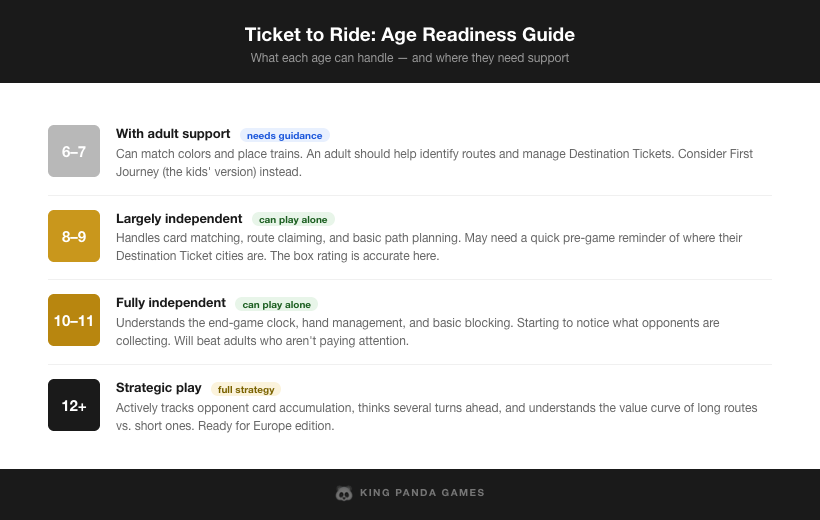
The box rating is conservative in some areas and accurate in others.
More accessible than 8+ suggests:
– Card matching is well within a 6–7 year old’s capability
– Route claiming — counting cards, placing trains — is genuinely simple
– The visual feedback (trains on a map) makes progress obvious and satisfying
Accurately 8+:
– Planning multi-city routes across a large map
– Deciding whether to keep or return Destination Tickets at setup
– Understanding the end-game clock and what it means when another player’s trains are running low
– Managing a large hand while thinking several turns ahead
A 7-year-old can play with adult guidance; a 9-year-old can play largely independently; a 12-year-old can play fully independently and start thinking about the strategic elements covered in our strategy guide.
How Adults Should Play With Kids
The biggest mistake adults make in family Ticket to Ride is playing to win.
This isn’t about letting kids win — that’s condescending and kids usually know it. It’s about not actively blocking their routes in ways that create helplessness. A child who spends four turns collecting blue cards for a specific route and then watches an adult claim it is not having fun. They can’t process the strategic reasoning fast enough to redirect gracefully.
Competitive adult play: Watch opponent card accumulation, claim routes preemptively, force alternatives.
Family play with kids: Focus on your own network, claim routes you need rather than routes that deny others, let the natural competition from map crowding create challenge organically.
As kids develop (typically 10+), they’ll start thinking about what you’re building and making strategic decisions in response. That’s when you can gradually introduce more competitive play.
Ticket to Ride First Journey — The Real Kids’ Version
If your children are under 8, or if you want a Ticket to Ride experience specifically scaled for young kids, Ticket to Ride: First Journey is worth knowing about. It’s a simplified version with:
- Smaller map (either USA or Europe)
- Only 15 trains per player (vs. 45 in the standard game)
- Simple rules — no Destination Ticket keep/return decision, tickets require only 1–3 routes to complete
- 15–30 minute play time
First Journey plays from age 6 and has won awards specifically for the children’s game category. It’s not an expansion — it’s a standalone, separately purchased game. Think of it as the on-ramp before the standard game rather than a replacement for it.
What Family Ticket to Ride Looks Like at Its Best
Done well, family Ticket to Ride produces exactly the kind of board game moment it was designed for: a map covered in colorful train routes, kids pointing out where their paths went, someone narrowly completing the cross-country ticket they weren’t sure about, and everyone wanting to play again.
The game doesn’t require anyone to be strategic to enjoy it. It rewards planning when players are ready for it, and it works as a pure route-building exercise when they’re not. That’s what makes it the right family game for a wide age range rather than a narrow one.
For the complete picture — rating, strategy, and which version to buy — see our full Ticket to Ride review.
Frequently Asked Questions
What age can kids play Ticket to Ride?
The official rating is 8+, which is accurate for independent play. Children as young as 6–7 can play with adult guidance, primarily handling the card-matching and train-placing while an adult assists with route planning. By age 9–10, most kids can play fully independently, and by 12, they’ll start applying real strategy.
Is Ticket to Ride a good gift for a family?
Yes — it’s one of the safest family board game gifts you can buy. It works across a wide age range, the rules are genuinely simple, and it plays in under an hour once everyone knows it. If the family has kids under 7, consider Ticket to Ride: First Journey instead, which is specifically designed for younger children.
How do you explain Ticket to Ride to a child?
Start with the goal: “You have two cities you need to connect with train tracks. You collect colored cards and use them to build tracks between cities.” Then show them one route claim in action. Most kids understand the mechanic within two turns of watching. The map makes it intuitive — they can see their tracks growing.
Is Ticket to Ride too competitive for family play?
Ticket to Ride is competitive, but the competition is mostly passive — building your own network rather than directly attacking opponents. Blocking someone’s specific route requires knowing their Destination Tickets, which are secret. For families with conflict-averse members, it’s a gentler competitive experience than games like Catan where negotiation and confrontation are explicit.
What’s the difference between Ticket to Ride and First Journey?
First Journey is a simplified version specifically for ages 6+: smaller map, fewer trains, simpler ticket mechanics, 15–30 minute play time. It’s a genuine standalone kids’ game, not just “standard Ticket to Ride with easier rules.” Standard Ticket to Ride is the complete game for ages 8+ and is the version most families will use long-term.
Does Ticket to Ride work for mixed ages at the same table?
Very well. It’s one of the better mixed-age games available because it rewards planning without requiring experience to participate. A 9-year-old and a 45-year-old can play at the same table and both have a genuine game. The 45-year-old will likely have better route efficiency, but the 9-year-old isn’t helpless — they’re building their own tracks and completing their own tickets.
King Panda Games