

This is the ranking for 7 Wonders Duel, the 2-player game. Playing the original 3–7 player 7 Wonders? Those seven boards are ranked here. Still deciding between the two games? Read 7 Wonders Duel vs 7 Wonders first.
The Wonder draft happens before a single card is played — and it shapes the entire game. Your four Wonders determine your win paths, your mid-game pivots, and occasionally your opening strategy. Drafting them well is the first strategic decision in 7 Wonders Duel, and most beginners treat it like an afterthought.
Here’s every Wonder ranked by strategic value, with notes on when each one earns its spot.
Some links below are Amazon affiliate links — as an Amazon Associate, King Panda Games earns from qualifying purchases at no extra cost to you. Full disclosure.
The Draft Matters Before the Rankings Do
Before getting into rankings, one drafting principle overrides all others: always consider what you’re denying your opponent.
The rule: a Wonder you don’t want but your opponent needs is often worth drafting just to remove it from their options.
If your opponent has been building shields and the Colossus (2 shields, immediate military push) is in the next group of four — draft it, even if you’d never build it. The denial matters. This is why Wonder power rankings can’t be applied mechanically — context changes everything. One thing the rankings assume: the pool is fixed at twelve. Pantheon adds two more Wonders alongside its divinities, which is the only way this list ever gets longer.
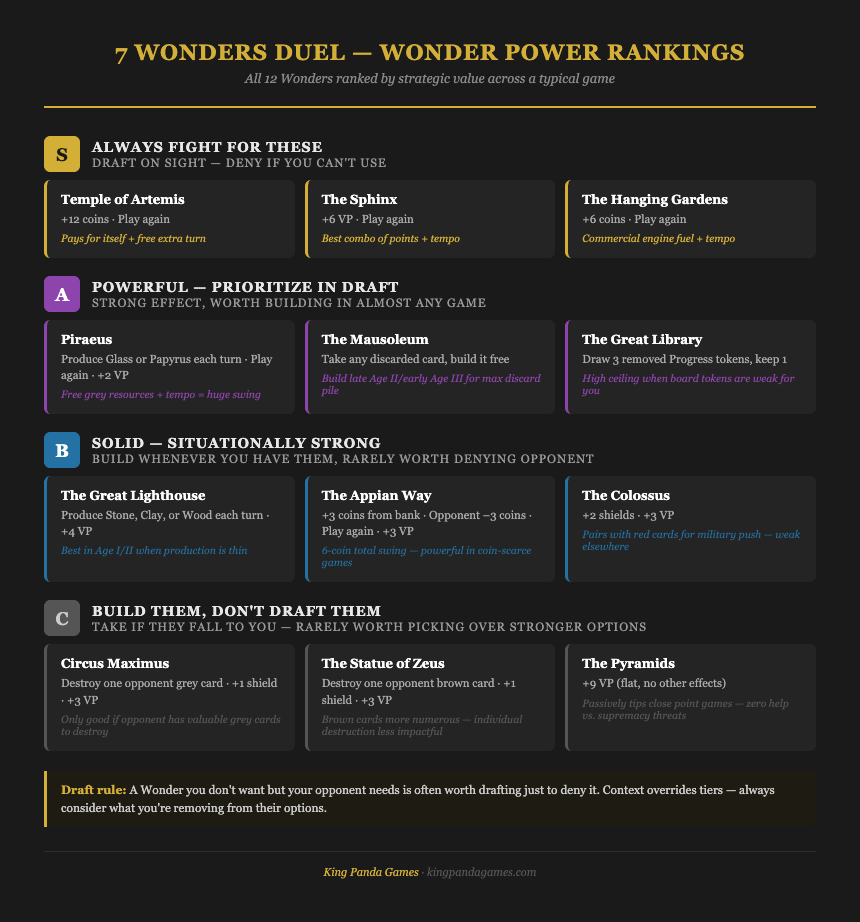
S-Tier: Always Fight for These
The Temple of Artemis is the strongest Wonder in the game when it hits early. It gives you 12 coins and an extra turn — the coins effectively pay for the Wonder’s own construction cost and fund your next two or three builds, and the free turn means no tempo loss at all. Draft this whenever you see it.
The Sphinx gives 6 VP and an extra turn for a reasonable resource cost. Extra turns are the most powerful effect in 7 Wonders Duel because they let you respond to a newly revealed card immediately — before your opponent can react. Two consecutive turns let you take a card your opponent was counting on and then build something yourself. The Sphinx’s 6 VP is also solid end-game insurance.
The Hanging Gardens is the coin-generation and tempo answer. You take 6 coins, you play again. If you’re in a commercial-focused game (lots of yellow cards, strong trade discounts), the Hanging Gardens can flood your treasury with enough coins to fund late-game construction without needing a production base. Strong at any point in the game.
A-Tier: Powerful, Worth Prioritizing
Piraeus produces Glass or Papyrus every turn and gives an extra turn. Grey resources are frequently the most expensive trades in the game — your opponent often has multiple grey cards, which inflates your purchase costs. Free grey production plus a play-again effect makes Piraeus one of the most efficient Wonders in the set. Slightly weaker than the S-tier because the production doesn’t impact trading costs and the VP value is only 2.
The Mausoleum lets you take any discarded card and construct it for free. The value depends entirely on what’s in the discard pile — which means timing matters. Building the Mausoleum at the end of Age II or beginning of Age III, when the discard pile is richest, produces the highest-ceiling outcomes. Grab a high-cost Age III card your opponent discarded. Grab the green card your opponent threw away thinking it was safe. The ceiling is enormous; the floor (building it early when little has been discarded) is low.
The Great Library randomly draws 3 Progress tokens from the 5 that were removed at setup, lets you keep 1, and returns the others. The removed tokens are unknown — but if there were 10 total and 5 are on the board, there’s a reasonable chance the ones removed include something powerful. If the on-board Progress tokens are weak for your position, the Great Library can surface something better. It’s high-variance but has a high ceiling when the timing is right.
B-Tier: Solid, Situationally Strong
The Great Lighthouse produces Stone, Clay, or Wood each turn (your choice each turn) and is worth 4 VP. Flexible raw material production is genuinely useful in Ages I and II, especially when your brown cards don’t cover all three resources. However, like all production Wonders, it doesn’t factor into trading costs — so it helps you but doesn’t tax your opponent’s trades. Worth building; rarely worth fighting for in the draft.
The Appian Way takes 3 coins from the bank, makes your opponent lose 3 coins, and gives you an extra turn and 3 VP. The coin swing (you gain 3, they lose 3) is a 6-coin total effect — significant in a game where construction costs 3–8 coins. The play-again effect adds tempo. This Wonder is best in games where both players are resource-rich and coins are the constraint; it’s weaker when either player is already coin-poor.
The Colossus is simply 2 shields and 3 VP. No extra effects, no tricks. Two shields moves the Conflict pawn two spaces immediately, which can cross zone boundaries and trigger Military tokens. In a military-focused game, the Colossus is excellent — building it alongside two or three red cards can push for military supremacy in a single Age. In a science or civilian game, it’s below-average.
C-Tier: Build Them, Don’t Draft Them
Circus Maximus removes one of your opponent’s grey cards (manufactured goods) from the game, gives 1 shield, and scores 3 VP. Destroying a grey card is powerful in principle — grey resources are expensive to trade for. But its value requires your opponent to have grey cards worth destroying, which isn’t always the case. Don’t draft this first; pick it up if it falls to you.
The Statue of Zeus removes one of your opponent’s brown cards (raw materials), gives 1 shield, and scores 3 VP. Same logic as Circus Maximus, but brown cards are usually more numerous and individually weaker. Removing one is less impactful than removing a key grey card. Build it if you have it; don’t fight for it in the draft.
The Pyramids is exactly 9 VP, no effects. That’s a strong point total — roughly equivalent to a chain of three blue civilian buildings. But it’s purely passive. No extra turn, no coin generation, no military, no production. In tight games decided by 2–3 VP, The Pyramids often tips the scales. In games with supremacy threats, it does nothing to help you defend or attack. Draft it late or pick it up as a fallback when stronger Wonders are gone.
How to Draft
The draft gives each player four Wonders from a random selection of eight. The format: first player picks 1, second player picks 2, first player picks 1 — then repeat with second player going first.
Prioritize in this order:
1. Any S-tier Wonder available
2. Deny your opponent’s obvious pairing (if they have the Colossus, consider drafting Circus Maximus to prevent a double-shield military engine)
3. Take the strongest available Wonder for your own strategy
4. In the final round, take the Wonder with the most flexible use case — avoid situational picks when your hand is already locked in
Don’t draft four play-again Wonders expecting to chain every turn. The chain only works if you build all of them, which requires sufficient resources at the right moments. Two play-again Wonders is a realistic target; four is overcommitting to a plan that can’t always execute.
For more on how Wonders fit into your overall game plan, see our full 7 Wonders Duel review.
Check 7 Wonders Duel: Pantheon price on Amazon →
Frequently Asked Questions
What is the best Wonder in 7 Wonders Duel?
The Temple of Artemis is the strongest individual Wonder — it generates 12 coins and an extra turn, essentially paying for itself and giving back tempo. The Sphinx is a close second for its combination of 6 VP and a play-again effect. Both should be prioritized when they appear in the draft.
How many Wonders can each player build?
Each player drafts 4 Wonders but can build at most 4 of them — with the constraint that only 7 Wonders total can be built across both players. When the 7th Wonder is completed, the 8th (the one that hasn’t been built) is immediately returned to the box. If both players have built 3 each and one builds their 4th, the other player’s remaining unchosen Wonder is eliminated.
Should you always build all four of your Wonders?
Not necessarily. If you reach Age III with one Wonder remaining and no good Age card to spend on it (since you need to sacrifice an Age card face-down to build a Wonder), it may not be worth forcing. In practice, though, Wonders are almost always worth building — even the weakest provide 2–3 VP and sometimes more, which is usually worth the construction cost.
Does Wonder order matter?
Yes. Wonders with coin generation (Temple of Artemis, Hanging Gardens) are best built early when the coins fund multiple future builds. The Mausoleum is best built mid-to-late when the discard pile is richest. Play-again Wonders (Sphinx, Piraeus) are most powerful when you can immediately use the extra turn to take a strategically important card — so build them when a key card is about to become accessible.
What happens if a Wonder gets removed before you build it?
When the 7th Wonder is built across both players, the 8th — whichever Wonder neither player has yet constructed — is immediately returned to the box. You lose it permanently. This creates a late-game race: if your opponent is building Wonders faster than you, your best unbuilt Wonder is at risk. Track Wonder counts in Age II and make sure to build your most valuable remaining Wonder before your opponent builds their 7th total.