

Some links below are Amazon affiliate links — as an Amazon Associate, King Panda Games earns from qualifying purchases at no extra cost to you. Full disclosure.
7 Wonders Duel earns 5/5 Pandas from us — the highest score we give — and it isn’t close. This is the best dedicated two-player strategy game available under $50, and it’s not a matter of opinion so much as the result of a decade of players arriving at the same conclusion. If you have a regular opponent and you don’t own this game, that’s the most fixable problem on this list. It lands at #4 on our best board games of 2026 list.
The 4/5 Bamboo Plants reflects one real caveat: the first game involves some confusion. Three distinct win conditions, a trading system that reacts to your opponent’s city, Wonder abilities, and Progress token effects all hit the table simultaneously. By the third game, you’ll play in 25 minutes and every decision will feel purposeful. The learning curve is short, but it’s real, and you should know about it before the box opens.
| Detail | Info |
|---|---|
| Players | 2 (exactly — not 1, not 3) |
| Age | 10+ |
| Play time | 20–30 min |
| Bamboo Plants | 4/5 — learning curve exists, but it’s short |
| Pandas | 5/5 — best-in-class two-player game |
| Official site | rprod.com |
How It Works
It’s Age II. You’re holding enough Stone and Wood to build the Aqueduct — a 5-point blue card that chains for free from your Age I Baths. Your opponent has been drawing green cards. They have two different science symbols already. If they get one more pair, they pick a Progress token. The Aqueduct takes your turn. But so does watching the science symbols stack up. You build the Aqueduct, and they take the School — adding a Wheel symbol, no matching pair yet. Exhale. Next turn, you might block the Library before it becomes a problem.
That tension — not just “what should I build” but “what am I letting them take” — is what 7 Wonders Duel does better than almost any other two-player game. Every card you take is a card your opponent can’t.
The structure is elegant. At the start of each Age, the 20 cards for that Age are laid out in an overlapping pyramid — some face-up, some face-down. A card is accessible when nothing covers it. On your turn, you pick any accessible card and do exactly one thing: build it (pay its cost, add it to your city), discard it for coins (2 coins plus 1 per yellow card you already own), or spend it face-down to construct one of your four Wonders (paying the Wonder’s cost, not the card’s cost).
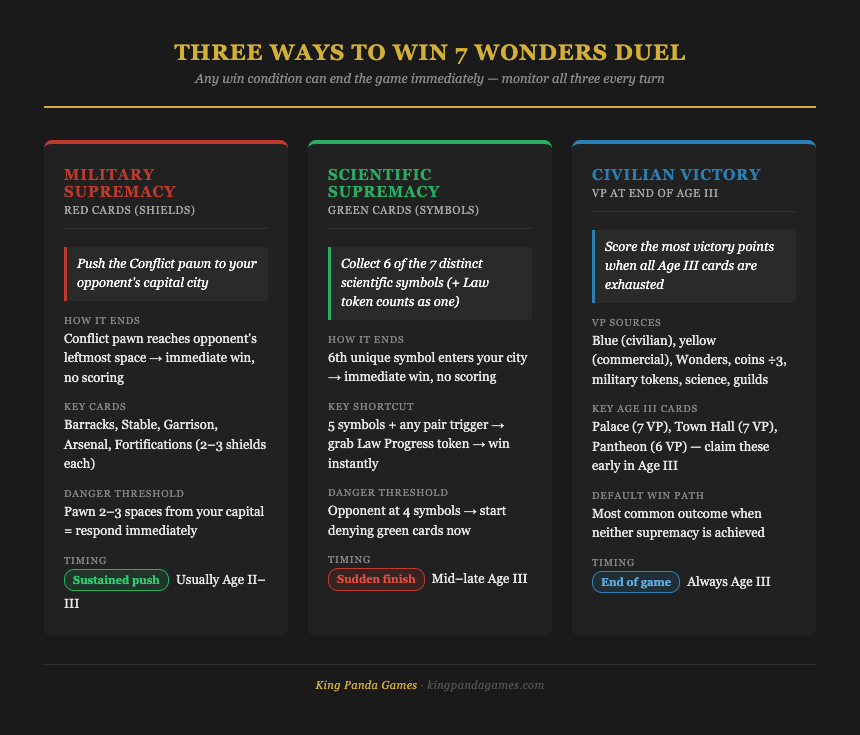
That’s the complete turn. The depth comes not from complex mechanics but from the three ways the game can end — military supremacy, scientific supremacy, or the most victory points at the end of Age III — and how every card choice shifts all three simultaneously.
Military works through a Conflict pawn on a 19-space track. Each shield symbol on a military building or Wonder moves the pawn one space toward your opponent’s capital. When the pawn crosses zone boundaries, the opponent loses coins (2 or 5, depending on the token). Reach their capital and you win immediately, regardless of score.
Science runs through 7 distinct scientific symbols on green cards and one Progress token. Collect a matching pair of any symbol and you immediately choose one of the five face-up Progress tokens — powerful one-time or persistent effects. Collect 6 different symbols and you win immediately.
Civilian victory is just points at the end of Age III: buildings, Wonders, Progress tokens, military position (0, 2, 5, or 10 points based on where the pawn sits), and 1 point per 3 coins in your treasury.
One rule newcomers always miss: resources are never spent. Your Stone production doesn’t go away when you build with it — it’s there every turn, for the whole game. This makes building a production base early a compounding investment, not a one-time cost.
What We Liked
Three live win conditions at all times. Most games have one way to win and variations on how fast. 7 Wonders Duel has three, and they’re genuinely competing. You can start a game targeting civilian points and find yourself six turns in with three different science symbols and a Progress token that adds a seventh symbol — suddenly scientific supremacy is live and your opponent knows it. The pivot feels earned, not arbitrary.
The trading system is one of the most underappreciated design achievements in modern board games. When you need a resource you don’t produce, you buy it from the bank — but the price is 2 coins plus the number of that same resource in your opponent’s brown and grey cards. If they’ve built heavily in Stone, Stone costs you more. Their city directly taxes your purchases. This means that building your own production isn’t just efficient — it starves your opponent’s economy at the same time.
What feels right on your first play: Build whatever cards seem most useful regardless of what your opponent is producing. Trade freely; coins feel plentiful early on.
What’s actually happening: Every brown or grey card your opponent builds is a tax on your future trades. Denying them a production card by taking it yourself — even if you don’t need the resource — can be worth more than whatever you’d have built instead.
The Wonder draft creates a new puzzle every game. Before cards are dealt, both players draft four Wonders from a random selection of eight. The twelve Wonders vary wildly: The Pyramids is simply 9 victory points. The Temple of Artemis gives 12 coins and an extra turn. The Mausoleum lets you grab any discarded card for free. The Colossus is 2 shields worth of military power. Which four you have shapes your entire game plan — and so do your opponent’s four.
Games end in 30 minutes. This sounds trivial, but it isn’t. A game this strategically rich playing in half an hour means you can play twice in an evening, learn from your first game immediately, and actually want to set it up again rather than feeling spent. The play time is perfectly calibrated.
Wonders with “Play Again” effects break the rhythm in satisfying ways. Four of the twelve Wonders give you an extra turn when built. The Sphinx, Hanging Gardens, Temple of Artemis, Piraeus — draft a couple of these and you can chain turns together, flipping face-down cards and building twice before your opponent responds. The first time you do it, the table shifts. Your opponent watches the board reset and has to recalculate.
What We Disliked
The first game is genuinely rough if nobody reads the rulebook in advance. Three win conditions, the trading formula, Progress token effects, chain building across Ages — none of this is complicated once you understand it, but it arrives simultaneously and the 20-page rulebook doesn’t teach it in the most intuitive order. We recommend one player reading it fully and teaching the other rather than both reading independently.
Randomness is real and occasionally punishing. Three cards are removed from each Age deck face-down before the game — you never know which ones. A Progress token you were planning around might not appear because it was among the five returned to the box during setup. The Mausoleum Wonder’s value depends heavily on what’s in the discard pile. None of this breaks the game, but it can frustrate experienced players who built a plan that gets dismantled by hidden information they couldn’t account for.
The two-player cap is a feature for some and a genuine limitation for others. If you regularly play with three or more people, this game cannot help you — it’s designed purely for one-on-one play. The original 7 Wonders handles groups of three to seven but is a completely different experience. If your household needs a game that scales, look elsewhere for your primary purchase and add Duel as a dedicated two-player option.
Who It’s For
Couples who want depth. This is the answer to every “what should we play tonight?” question for two people who like thinking. It fits in 30 minutes, plays fast enough to try again immediately, and has enough strategic variety across games that the first hundred plays don’t feel repetitive. If you and a partner play board games regularly, buy this game. It sits at #1 on our best board games for couples list, and nothing else we’ve reviewed is close.
Anyone who’s outgrown their gateway games. Played through your Ticket to Ride collection and want more to chew on? 7 Wonders Duel is the natural next step. It keeps the accessible turn structure — you’re doing one simple thing on your turn — while layering in genuinely complex decision-making through competing priorities.
Competitive players who want a compact game. This is a game you can master in a way that Catan and Ticket to Ride don’t allow. The reduced randomness compared to dice-rolling games makes it feel more like a contest of skill. High-level players have developed opening theories, Wonder draft priorities, and endgame calculations that reward study. The ceiling is genuinely high.
Not for total beginners as a first board game. It’s not hostile, but it’s not the right entry point. Start with Ticket to Ride or Carcassonne to learn how modern games work, then add Duel once card management and strategic planning feel natural.
Awards
7 Wonders Duel won the Kennerspiel des Jahres in 2016 — Germany’s Expert Game of the Year award, given to mid-weight games that demonstrate exceptional design for experienced players. This is the most credible award in board gaming, and winning it as a two-player-only game is unusual. The judges recognized what players had already confirmed: this isn’t just a variant of the original 7 Wonders, it’s a stronger design for its specific use case.
How It Compares
7 Wonders Duel vs. the original 7 Wonders — the original plays 3–7 players and uses a card-drafting mechanism where everyone plays simultaneously. It’s a great group game. Duel uses a completely different system — the pyramid structure, the single shared display, the three win conditions — specifically because drafting doesn’t work well at two players. They share a theme and some card DNA, but they’re not interchangeable. Own both if you play both player counts; 7 Wonders Duel vs 7 Wonders goes through the choice. If you only need a two-player game, Duel wins decisively.
7 Wonders Duel vs. Ticket to Ride — Ticket to Ride is more accessible and scales better (2–5 players). Duel is deeper and faster at two. If you’re choosing a primary two-player game, Duel. If you need something that works across a range of player counts and experience levels, Ticket to Ride.
7 Wonders Duel vs. Catan — Catan requires 3–4 players and centers on negotiation; Duel is purely two-player and purely strategic. They target different situations. For a couple, Duel is a better core game. For a group, Catan fills a role Duel can’t.
Tips & Tricks
1. Track the military pawn, always.
The military tokens deal 2 and 5 coins when the pawn crosses zones. Losing 5 coins mid-game is devastating — it can erase a full turn of resource accumulation and prevent you from building something you planned. Even if you’re not pursuing military supremacy, don’t let the pawn drift past the first zone marker on your side. One or two red cards per age is often enough to stay safe.
2. Science pairs matter more than individual symbols.
The rule: each pair of identical symbols earns a Progress token. Six different symbols wins the game outright. These are different goals — don’t confuse them.
Most players see green cards and think “collect 6 different symbols.” Experienced players see green cards and think “which symbols can I pair, and which Progress tokens does that unlock?” The Progress tokens vary wildly in power — Economy, Strategy, and Theology can shift games by themselves. Pairing for them is worth more than diversifying symbols unless scientific supremacy is genuinely in range.
3. Chain building is free money — plan for it in Age I.
Some Age II and Age III cards can be built for free if you own a specific Age I card. The Baths (Age I) unlocks the Aqueduct (Age II, worth 5 points) for free. The Scriptorium unlocks the Library. The Tavern unlocks the Lighthouse. These chain symbols are small icons in the cost area — easy to miss on a first play. Look for them during Age I setup and prioritize the Age I card if the Age II payoff is significant.
You’re in Age I. The Scriptorium costs 2 coins and gives you a science symbol plus a chain icon. It seems weak — 2 coins for one early symbol. But it chains to the Library in Age II, which costs 2 Stone and 1 Papyrus, or is free if you own the Scriptorium. That’s at minimum 4 coins of trading cost eliminated. The Age I card was paying for the Age II card the whole time.
4. Discarding is an action, not a surrender.
New players almost never discard deliberately. The discard action gives you 2 coins plus 1 per yellow card in your city — and more importantly, it removes a card from your opponent’s accessible options. A card that does nothing for you might be the exact resource your opponent is missing for their next Wonder. Taking it face-down for 2 coins is a legitimate play. It generates economy and denies access simultaneously.
5. The 7-Wonder limit creates a late-game cliff.
Only 7 Wonders can be built across both players — when the 7th goes down, the 8th is immediately removed from the game. If one player is building Wonders faster, they can force the other player’s last Wonder off the board. Track Wonder counts in Age II and III. If your opponent has built 4 and you’ve built 2, their 5th Wonder triggers the removal of your best remaining one unless you build it first.
Frequently Asked Questions
🎋 Budget Board Games
Best Board Games Under $30
At ~$28, 7 Wonders Duel is the best strategic 2-player game under $30. It made our curated budget board game list.
Not sure whether 7 Wonders Duel is the right step for your group? It is number 5 of 12 on our strategy board games list, ranked easiest to hardest to learn.
Is 7 Wonders Duel worth buying?
Yes — emphatically, for two-player households. It’s the best dedicated two-player strategy game in its price range, plays in 30 minutes, and has enough strategic depth to stay interesting across years of play. If you and a partner or regular opponent like board games at all, this is one of the most efficient purchases you can make.
Can you play 7 Wonders Duel with more than 2 players?
No. The game is designed exclusively for two players and cannot be expanded to three or more. It’s not a limitation of the components — it’s the entire design. If you need a game that scales, the original 7 Wonders plays 3–7 players, but it’s a completely different game. For groups of three or more, look at Catan or Ticket to Ride instead.
How long does a game of 7 Wonders Duel take?
An experienced game runs 20–30 minutes. First plays take 45–60 minutes while both players learn the rules and stop to check card effects. By the third or fourth game, 30 minutes is realistic. The play time is one of the game’s major selling points — it’s short enough to play twice in an evening without either player feeling tired of it.
What’s the difference between 7 Wonders Duel and 7 Wonders?
The original 7 Wonders plays 3–7 players using simultaneous card drafting — everyone picks from a hand of cards at the same time. Duel uses a completely different pyramid structure designed specifically for two players, adds a military track, introduces three distinct win conditions, and runs in half the time. They share a theme and some card DNA but are genuinely different games. Duel is not just “7 Wonders with two people.” Full head-to-head, player counts and all: 7 Wonders Duel vs 7 Wonders.
What does scientific supremacy mean?
If you collect 6 different scientific symbols — spread across green cards and one Progress token — you immediately win the game, regardless of score or turn. There are 7 different symbols total, so you need any 6 of them. This can happen before Age III ends. Your opponent can prevent it by denying you key green cards or taking the Law Progress token (which counts as a symbol) before you can.
How does military supremacy work?
There’s a Conflict pawn on a military track between the two players’ capitals. Each shield symbol on red cards or Wonders moves the pawn one space toward your opponent’s capital. If the pawn reaches their capital space, you win immediately — no scoring required. Along the way, zone crossings trigger Military tokens that make your opponent lose 2 or 5 coins. Military supremacy is the rarest of the three win conditions but always threatens when one player pushes shields aggressively.
Is 7 Wonders Duel hard to learn?
Harder than Ticket to Ride, easier than most “heavy” strategy games. The mechanics are genuinely simple — pick a card, do one thing — but understanding the three win conditions, trading costs, chain building, and Progress tokens all at once takes one full game to absorb. We recommend one person reading the rulebook and teaching the other, rather than both reading and trying to parse it simultaneously. By the second game, it clicks.
Should I buy the Pantheon or Agora expansion?
Neither is necessary and both are better appreciated after 15+ plays of the base game. Pantheon adds Greek and Roman gods that can be activated during play; Agora adds a Senate track as a fourth win condition. Both are well-designed, but the base game is complete on its own and plays excellently without them. Add expansions when the base game’s depth stops surprising you — which takes longer than most players expect.
Want to Go Deeper?
- 7 Wonders Duel Strategy Guide — When to pursue military vs. science vs. points, how to read the board by Age II, and the decisions that separate consistent winners from beginners. Read it here
- The Best Wonders in 7 Wonders Duel, Ranked — Not all four of your Wonders matter equally. Here’s how to evaluate the draft and which Wonders are worth fighting for. Read it here
- How to Win by Scientific Supremacy — The fastest path to an immediate win, how to set it up without telegraphing it too early, and when to abandon the science path and pivot. Read it here
- 7 Wonders Duel vs. 7 Wonders: Which Should You Buy? — Same world, completely different game. A mechanic-by-mechanic breakdown of which version fits your situation. Read it here
- Progress Tokens Explained — All 10 Progress tokens ranked by power, when to prioritize each one, and which pairings break games wide open. Read it here
Verdict
Buy it if you have a regular two-player opponent and any interest in strategy games. This is a 30-minute game that plays like a longer one, rewards study, and stays interesting across hundreds of plays. It’s as close to a mandatory purchase as we make. Skip it if you need a game that works for three or more players — this game simply doesn’t do that. Try before you buy if you’ve never played a game with multiple win conditions — the first session involves some overhead that’s worth experiencing before committing.
7 Wonders Duel official site: rprod.com/en/games/7-wonders-duel