

How to Win at Spirit Island: Strategy Guide for Beginners
Your group has lost three games in a row. The Blight card flipped. The Invaders ravaged half the island before you could respond. Someone’s spirit got wiped. You’re not sure what you could have done differently.
Some links below are Amazon affiliate links — as an Amazon Associate, King Panda Games earns from qualifying purchases at no extra cost to you. Full disclosure.
Here’s the honest answer: almost everything. Spirit Island has a steep learning curve not because the rules are complicated but because the priorities are completely non-obvious for new players. The way experienced players think about the game is almost the opposite of how beginners naturally approach it.
These five principles are what actually explain why new groups lose — and what to change.
For the full game overview, read our Spirit Island review first.
Once the base game feels manageable, see the best Spirit Island expansions.
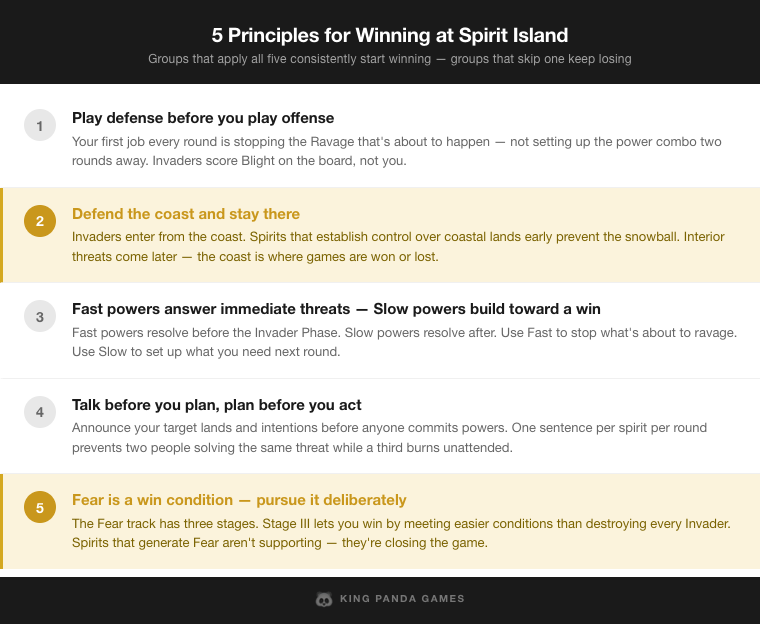
Principle 1: Play Defense Before You Play Offense
The single most common reason new groups lose Spirit Island is that they chase Invader pieces too aggressively while ignoring Ravage prevention.
New players read the win condition — destroy the Invaders — and naturally try to destroy Invaders. The problem is that Invaders Ravage the turn after they Build. A Town that builds on Turn 2 will Ravage on Turn 3. If you’re spending your powers killing Explorers two lands away, that Town is going to deal Blight and damage your Dahan before you’ve touched it.
The Invader Phase is a pipeline: Explore → Build → Ravage. Every Explorer that lands becomes a Town. Every Town becomes a Ravage threat. The pipeline doesn’t stop. Your job isn’t to run down the pipeline eliminating each piece — it’s to prevent Ravage in the specific lands where Blight is about to be placed.
The rule: in your planning phase, identify which lands will Ravage this round and make preventing or surviving those Ravages your first priority. Then spend remaining power cards on disrupting future rounds. Offense comes third.
Principle 2: Defend the Coast — and Stay There
Invaders always enter the island from the coast. They Explore into coastal lands first, Build there next, Ravage there after that. And then — unless you stop them — they push inland.
New players spread their Presence evenly across the island because it feels right to cover everything. This is wrong. Experienced players push their spirits hard into coastal lands early, dominate those lands, and only move inland when the coast is under control.
Why this works: a coastal land you control generates no new Invaders. The Invader deck explores into unprotected coastline, not into your controlled lands. If you bottle up the Invader pipeline at the source, the interior of the island stays clean, your Dahan stay alive, and you have breathing room to manage fear and build toward a win condition.
If you let the coast go and try to fight the Invaders in the interior, you’re fighting a tide that keeps refreshing. The Invaders don’t run out of cards. You can’t outrace them by killing pieces inland while new ones land behind you.
The rule: establish coastal presence in the first three rounds, before the Invader pipeline fills those lands with Towns. You can always extend inland. You can’t easily reclaim a coast that’s already been built up.
Principle 3: Fast Powers Answer Immediate Threats — Slow Powers Build Toward a Win
Every power card in Spirit Island is either Fast (resolves before the Invader Phase) or Slow (resolves after). New players frequently play Slow powers to answer immediate threats — powers that deal damage or prevent Ravage — and the Ravage resolves before their cards fire.
Fast powers answer now. Slow powers set up what happens next.
A Slow power that would prevent a Ravage doesn’t prevent that Ravage — it’s already happened. Slow damage powers kill pieces that have already done their harm. The distinction matters enormously when you’re planning which cards to play each round.
The practical framework:
- To prevent a Ravage this round: you need a Fast Defend or Fast Damage power that fires before the Invader Phase
- To set up next round: Slow powers are fine — they resolve before the next Explore, giving you board presence heading into the following Invader Phase
- To generate Fear: most Fear powers are Slow, and that’s fine — Fear accumulates and the track advances regardless of phase timing
Read the speed icon on every card before you play it. The Slow/Fast distinction is the most commonly missed rule in Spirit Island, and missing it costs games.
Principle 4: Talk to Each Other Before You Plan
Spirit Island is a cooperative game that can be played almost entirely in silence — and groups that do this lose much more often than groups that don’t.
Before you commit your Growth action and power cards for the round, your team should share three things:
1. What threats are you each seeing? Name the specific lands and the specific Ravage or Build that’s coming.
2. What can you each cover? Tell your teammates what your powers can do this round — don’t make them guess.
3. What are you not covering? The gaps are the actual problem. Once you know what no one is handling, you can decide whether someone needs to redirect or whether you’re accepting Blight.
The failure mode in Spirit Island isn’t usually “we each played our spirit badly.” It’s “we each played our spirit fine, but we were covering the same three lands while the other four went undefended.” Coordination fails at the planning stage, not the execution stage.
The rule: spend two minutes talking before each round. It feels slow. It wins games.
Principle 5: Fear Is a Win Condition — Pursue It Deliberately
Every game of Spirit Island has two parallel tracks toward victory: clearing Invaders from the board and advancing the Fear track. Most new groups focus almost entirely on the board state and barely track the Fear deck.
This is leaving one of your best win conditions on the table.
The Fear track has three stages. In Stage I, you win by completely clearing Invaders from the board. In Stage II — reached after enough Fear tokens accumulate — you win by reducing Invaders to a much smaller threshold. In Stage III, the next Fear card wins the game outright. Advancing the Fear track makes your win condition dramatically easier.
Many Spirit Island powers generate Fear as a secondary effect. Some spirits (Shadows Flicker Like Flame, Bringer of Dreams and Nightmares) are built almost entirely around Fear generation and can push the Fear track to Stage III before the board even looks clean. A group that ignores these powers in favor of raw damage is working harder toward a harder version of winning.
The rule: every round, ask “what Fear did we generate?” If the answer is zero or one, you’re leaving a win condition underutilized. Prioritize powers that generate Fear alongside their primary effect. A power that deals 2 Damage and generates 2 Fear is almost always better than a power that deals 4 Damage.
The Checklist for Your Next Game
Before you sit down to play again:
- [ ] Identify which lands Ravage this round before playing any power cards
- [ ] Confirm at least one Fast power is available for emergency threat response
- [ ] Distribute coastal lands between spirits before the game starts — don’t overlap
- [ ] Talk through the board before each round’s planning phase
- [ ] Count Fear generated each round — aim for at least two per spirit per round
Start at Difficulty 0. Win twice. Then add the first Adversary level. Spirit Island’s learning curve is real, but it has an end — and what’s on the other side is the best cooperative game experience in board gaming.
Don’t own Spirit Island yet? This guide assumes the base game.
Check Spirit Island price on Amazon →
Frequently Asked Questions
Why is Spirit Island so hard for new players to win?
Spirit Island's difficulty for beginners isn't about complex rules, but counter-intuitive priorities. New players often chase Invaders aggressively, which is the opposite of what actually prevents losses and secures the island. You need to unlearn natural gaming instincts to succeed.
Should I focus on destroying Invaders in Spirit Island?
Absolutely not, at least not initially. New players mistakenly prioritize killing Invaders, but your real job is preventing Ravage and Blight *this* turn. Focus on defense first; offense against Invader pieces comes much later, after you've secured the immediate threats.
What's the most critical strategy for beginners in Spirit Island?
The single most critical strategy is to prioritize Ravage prevention over chasing Invaders. Identify which lands will Ravage this round and commit your powers to stopping or surviving those threats first. Only after securing the immediate danger should you consider disrupting future Invader plans.
Where should I place my Presence tokens early in Spirit Island?
Concentrate your Presence heavily on coastal lands in the first few rounds, and stay there. New players often spread out, but bottling up the Invader pipeline at its source on the coast is far more effective. This prevents new Invaders from pushing inland and gives you crucial breathing room.
How do I stop Invaders from ravaging my island in Spirit Island?
To stop Ravages, you must proactively identify which lands are about to Ravage and dedicate your powers to preventing Blight there. Don't waste energy killing Explorers far away; focus on the Towns that are one step away from dealing damage. Defense is your primary weapon against the Invader pipeline.
Is it better to spread my Presence or concentrate it in Spirit Island?
Definitely concentrate it, especially early on the coast. Spreading your Presence evenly feels intuitive but leaves you vulnerable everywhere. Experienced players dominate coastal lands to choke off the Invader supply, keeping the interior clean and manageable.
What is the 'Invader pipeline' in Spirit Island and why does it matter?
The 'Invader pipeline' describes the relentless cycle of Explore → Build → Ravage. It matters because new Invaders are constantly flowing in, and you can't outrace them by just killing pieces. Your goal is to disrupt this pipeline by preventing Ravages and controlling the coastal entry points, not just eliminating individual Invaders.