

Spirit Island Review: Is It Worth It?
Spirit Island earns a 5/5 Pandas and a 2/5 Bamboo Plants — and both scores are completely deserved. This is the best cooperative board game ever made. It is also a game that will hand a new group their heads on a platter for the first two or three sessions while they figure out how it actually works.
Some links below are Amazon affiliate links — as an Amazon Associate, King Panda Games earns from qualifying purchases at no extra cost to you. Full disclosure.
The 5/5 Pandas is earned because no other cooperative game generates this level of strategic depth, replayability, and genuine teamwork. The 2/5 Bamboo Plants is honest: the rulebook is dense, the first few turns are disorienting, and the game punishes passivity in ways that aren’t obvious until you’ve already lost. If your group is looking for an accessible cooperative game, this is not it. If your group wants the most satisfying cooperative experience in modern board gaming — one where victory at difficulty 4 feels genuinely earned — Spirit Island is the answer. It lands at #8 on our best board games of 2026 list.
Buy it if your group has patience for a steep learning curve, enjoys deep strategy, and wants a cooperative game with near-infinite replayability. Skip it if you need something teachable in 15 minutes or if your group gets frustrated losing repeatedly while learning. Try before you buy if you’re unsure whether the complexity suits your group — borrow a copy or play on Tabletop Simulator first.
| Detail | Info |
|---|---|
| Players | 1–4 (up to 6 with expansions) |
| Age | 13+ |
| Play time | 90–120 min |
| Bamboo Plants | 2/5 — expect 2–3 full games before it clicks |
| Pandas | 5/5 — nothing else comes close for cooperative play |
| Official site | greaterthangames.com |
How Spirit Island Works
You and your teammates are ancient spirits defending a Pacific Northwest island from colonization. The Invaders — represented by Explorer, Town, and City pieces — arrive on the shore, establish settlements, and spread inland, ravaging the land and driving out the island’s native Dahan people. Your job is to destroy the Invaders, protect the land from Blight, and generate enough Fear to drive them away before the island is overwhelmed.
Every round runs in a strict sequence. The Invader Phase resolves first and it’s unforgiving: Explorers spread into new lands, Towns build where Explorers already stand, and Cities ravage wherever Towns have taken root. Ravaging deals Blight — the game’s lose condition — and damages the Dahan. You don’t control when this happens. You can only position your powers to interrupt, prevent, or respond to each step.
Before the Invaders act, you have your Spirit Phase. Each spirit has a Presence track (a personal board showing what you can do and how much energy you generate), a starting hand of powers, and a Growth action that lets you expand your reach, gain energy, and reclaim spent cards. On your turn, you decide how to grow, then play power cards from your hand — paying their energy cost — that take effect either Fast (before the Invaders act) or Slow (after). Reading when to use Fast versus Slow powers is one of the first real skills the game teaches.
The Fear track is the other path to victory. Most powers that kill Invaders or trigger specific events generate Fear tokens. When enough tokens accumulate, the Fear deck advances — changing the win condition from “clear all Invaders” to “reduce Invaders below a threshold” to, eventually, “generate one more Fear card and win outright.” Playing aggressively toward Fear generation is often more efficient than trying to destroy every piece on the board.
Each spirit plays completely differently. Lightning’s Swift Strike hits fast and often; Vital Strength of the Earth is a defensive anchor that builds slow and hits hard late. Shadows Flicker Like Flame spreads Fear through the interior while barely showing up on the map. Ocean’s Hungry Grasp pushes Invaders into the sea — a mechanic that exists nowhere else in the game. Choosing which spirits complement each other in a multiplayer game is a meaningful decision before you’ve placed a single piece.
What We Liked
Every spirit is a different game. We have played Spirit Island over thirty times across several groups. We have never played it the same way twice. Switching from River Surges in Sunlight to Bringer of Dreams and Nightmares isn’t a minor adjustment — it’s learning a new set of priorities, a new relationship with the board, and a new way of thinking about the Fear track. Eight base spirits means eight essentially different games before you’ve bought a single expansion. The expansions add dozens more.
Losing is instructive. Most cooperative games feel arbitrary when you lose — bad cards, bad luck, nothing you could have done. Spirit Island losses almost always have an identifiable cause. You stretched too thin. You let a coastal land Ravage twice. You over-invested in one region and the Invaders built unchecked in another. The post-game debrief after a Spirit Island loss is one of the most valuable learning experiences in board gaming. “We lost because of that” is a sentence your group will say often, and it makes winning eventually feel genuinely earned.
The difficulty system is exceptionally well-designed. Spirit Island at difficulty 0 is beatable by most groups after one or two sessions. At difficulty 6 (England Level 6 Adversary), winning requires coordinated multi-spirit plays that most experienced groups still find challenging. This isn’t arbitrary scaling — each difficulty level introduces specific new pressures that require adapting your strategy rather than just playing faster. Your group will grow with the game’s difficulty curve in a way most games can’t replicate.
It rewards communication. The game is explicitly cooperative and explicitly won or lost based on how well your group shares information. “I can prevent the Ravage in land 3 if you push the Explorer out of land 5 before the Invader Phase” is a real Spirit Island conversation. Teams that talk well win. Teams that play individually, barely consulting each other, lose — sometimes catastrophically. The game punishes isolation and rewards coordination in a way that’s deeply satisfying when it works.
The thematic inversion is one of the best ideas in modern board gaming. Almost every Eurogame casts you as a colonizer — settling land, building cities, expanding resource extraction. Spirit Island inverts this entirely. You are the land defending itself. The Invaders are the threat. The Dahan — the indigenous people — are your allies. This isn’t just cosmetic flavor; it shapes every mechanic in the game. Cities are threats to be destroyed, not goals to build. Spread is the enemy. Blight is the measure of harm being done to the world you’re protecting. It changes how the game feels in a way that’s impossible to ignore once you’ve noticed it.
What We Disliked
The first two games are not fun. This is the honest truth about Spirit Island that most reviews undersell. The rulebook is long, the setup is complex, the sequence of phases is easy to mix up, and the game will methodically destroy your group while you’re still trying to remember what Ravage means. Most groups need two full sessions — both losses — before the game starts to click. If your group has low tolerance for losing while learning, you will quit Spirit Island before it gets good. Plan for this explicitly. Tell your group before session one: “We will probably lose. That’s fine.”
Solo and two-player are harder than four-player. The game scales by adjusting Invader cards and removing one card from the Fear deck per missing player — but the spirit synergies that make the game hum require multiple complementary spirits working together. A solo game with one spirit trying to cover the entire map is significantly harder than four spirits dividing responsibilities. This isn’t a flaw, but solo and two-player groups should expect to play at lower difficulty settings than they might assume. Read our Spirit Island solo guide for more.
Setup takes 15–20 minutes. Sorting land cards, setting up the Invader deck, placing starting Presence, distributing Fear tokens — Spirit Island setup is the most involved of any game we’ve reviewed. Experienced players get it down to 10 minutes with a good organizational system, but first-timers should budget a full half hour before the first turn. Consider investing in an insert or box organizer.
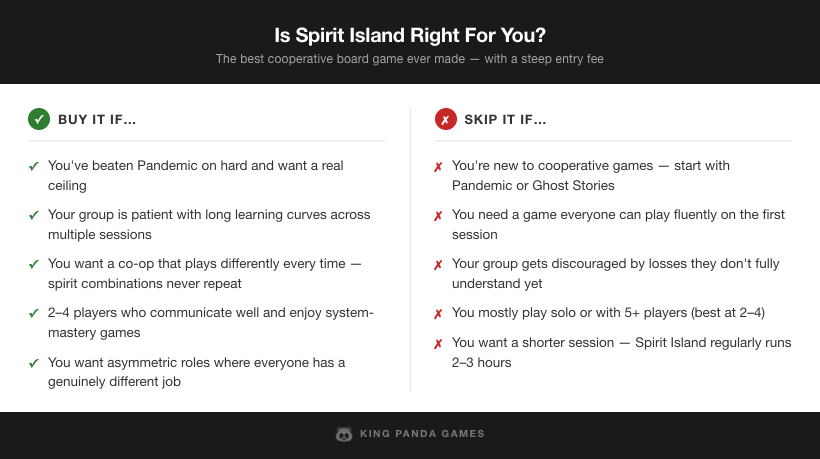
Who Spirit Island Is For
Experienced gamers who want the deepest cooperative challenge available. If your group has played Pandemic, loved it, beat it repeatedly, and wants something that will challenge you for years rather than months — Spirit Island is the next level. It assumes strategic maturity and rewards it.
Groups that love post-game analysis. Talking through what went wrong, what the better move was, how two spirits could have coordinated better — this is a significant part of the Spirit Island experience. Groups that enjoy this kind of debrief get enormous extra value from the game.
Solo players who want a legitimate mental challenge. Spirit Island is one of the best solo board games in existence. One spirit, one board, full concentration — it plays in 60–75 minutes solo and delivers a complete, demanding experience. The difficulty dial means you can calibrate exactly how hard a challenge you want.
Families with older teens. The 13+ rating reflects the complexity more than any content concern. A sharp 14- or 15-year-old who’s comfortable with complex games will thrive at Spirit Island. A group of adults who rarely play board games will struggle.
It’s not for groups new to modern board games, anyone who wants to win regularly from the start, or situations where you need something teachable quickly. For those groups, try Carcassonne for something calm or Catan for social chaos — then come back to Spirit Island once the hobby has a grip on them.
Check Spirit Island price on Amazon →
Awards
Spirit Island won the Golden Geek Award for Best Cooperative Game in 2017 and has appeared on numerous “best board games ever made” lists from major tabletop publications. It holds a top-10 position on BoardGameGeek’s all-time rankings — a remarkable achievement for a game published by a small independent studio. Designer R. Eric Reuss spent years in development, and the depth of the final product reflects it.
How Spirit Island Compares
Pandemic is the natural comparison — both are cooperative games where players take specialist roles to combat a spreading threat. Pandemic is dramatically more accessible: teachable in 20 minutes, completable in 60, with a difficulty curve that tops out well below Spirit Island’s ceiling. If your group wants cooperative without the commitment, Pandemic is the right choice. If you’ve beaten Pandemic on Heroic and want the next level, Spirit Island is exactly that. [link: once published, link to /pandemic-review/]
Arkham Horror: The Card Game is the other landmark cooperative game in Spirit Island’s tier. Arkham is narrative-driven and campaign-based; Spirit Island is systems-driven and infinitely replayable. Both are excellent. Arkham rewards story investment; Spirit Island rewards strategic mastery. They’re different enough to coexist in a collection. [link: once published, link to /arkham-horror-lcg-review/]
Ghost Stories is a cooperative game with a similar theme of supernatural defense, at a much lower price and complexity point. Ghost Stories is brutal and elegant; Spirit Island is complex and expansive. If your group wants cooperative difficulty without the full Spirit Island commitment, Ghost Stories is worth trying first.
Tips & Tricks
Pick complementary spirits, not just powerful ones. The best two-spirit combinations in Spirit Island pair a fast-aggressive spirit with a slow-defensive one — or pair spirits that cover different regions efficiently. Lightning’s Swift Strike (fast, mobile) and Vital Strength of the Earth (slow, immovable) is one of the best beginner pairings because their weaknesses barely overlap.
Defend the coastline first. Invaders always enter from the coast. New players spread their Presence evenly across the island. Experienced players push hard into coastal lands early — where Explorers arrive, Towns build, Cities Ravage — and only extend inland when the coast is controlled. Letting a coastal land Ravage twice in the first three rounds is usually fatal.
Read your power cards for Defend, not just Damage. New players optimize for cards that deal the most damage. Spirit Island often rewards powers that add Defend ratings (absorbing Ravage damage), push Invaders into unfavorable positions, or generate Fear without requiring you to kill pieces. “2 Fear and push 1 Explorer” is often a better play than “deal 3 Damage” if that Explorer would otherwise generate a Build next round.
Use the Dahan. The island’s native people fight back — each Dahan piece deals 2 Damage during Ravage if Invaders are present. Positioning your powers to bring Dahan into contested lands before a Ravage resolves is one of the highest-efficiency plays in the game. Thunderspeaker builds their whole strategy around this; every other spirit should still be doing it opportunistically.
Start at Fear Level 0, no Adversary. Every new group should play their first game at base difficulty — no Adversary, no Scenario. Learn the sequence. Learn how the Fear track works. Lose, probably. Then try Difficulty 1. The difficulty dial exists precisely so you don’t have to beat your head against a difficulty wall while you’re still learning the rules.
Want to Go Deeper?
- How to Win at Spirit Island: Strategy Guide for Beginners — The principles that explain why new groups keep losing, and how to fix them. Read it here
- Spirit Island Spirits Ranked: Best Spirits for Beginners — Not all spirits are equal for new players. Here’s where to start. Read it here
- Spirit Island Difficulty Settings Explained — A guide to every Adversary, every level, and how to calibrate the challenge for your group. Read it here
- Spirit Island Solo: Is It Worth Playing Alone? — The honest answer, plus which spirits and settings work best for one player. Read it here
- Spirit Island Expansions Ranked: Which One Should You Buy First? — Branch & Claw, Jagged Earth, Nature Incarnate — here’s the order that makes sense. Read it here
Verdict
Buy it — if your group can handle the learning curve. Spirit Island is the most rewarding cooperative board game ever designed. It will challenge you, teach you, and give you years of replayable content across its base game alone. Victory at high difficulty genuinely feels like an achievement.
Skip it if your group wants to win from the first session, needs a game teachable in under 20 minutes, or doesn’t have the patience for a game that punishes new players while they learn. There are better starting points, and Spirit Island will still be here when you’re ready.
Try before you buy if you’re unsure whether the complexity suits your group. Play it online or with someone who owns it first. The first game is not representative of what Spirit Island becomes — but it is representative of what you’ll experience while learning it.
Spirit Island official site: greaterthangames.com
Not sure whether Spirit Island is the right step for your group? It is number 11 of 12 on our strategy board games list, ranked easiest to hardest to learn.
Frequently Asked Questions
Is Spirit Island worth buying?
Yes, absolutely, if you crave the deepest cooperative strategy available. It's a 5/5 Pandas game for its unparalleled depth, genuine teamwork, and near-infinite replayability, making every victory feel genuinely earned.
How difficult is Spirit Island to learn?
Spirit Island has a notoriously steep learning curve, earning a 2/5 Bamboo Plants for its dense rulebook and disorienting first few sessions. Expect to play two or three full games before the core mechanics truly click and you start to strategize effectively.
What makes Spirit Island different from other cooperative board games?
Spirit Island stands apart by offering an unmatched level of strategic depth, genuine teamwork, and near-infinite replayability. Unlike many co-ops, it demands proactive, complex planning and punishes passivity, creating an incredibly satisfying challenge.
Can I play Spirit Island solo or with just two players?
Yes, Spirit Island shines at all player counts from 1 to 4, and even up to 6 with expansions. The strategic depth and cooperative nature scale beautifully, ensuring a challenging and engaging experience whether you're playing alone or with a full group.
Why do I keep losing my first few games of Spirit Island?
Don't worry, losing repeatedly in your first few Spirit Island games is completely normal and expected. The game punishes passivity and requires a nuanced understanding of Fast versus Slow powers, which isn't obvious until you've experienced the Invaders' unforgiving actions firsthand.
What is the core objective in Spirit Island?
Your primary goal in Spirit Island is to defend the island from colonizing Invaders by destroying their settlements, protecting the land from Blight, and generating enough Fear to drive them away. You're constantly reacting to the Invaders' relentless spread while positioning your spirits to interrupt and respond.
Is Spirit Island a good game for new board gamers?
Absolutely not, if you're looking for an accessible entry point into board gaming. Spirit Island is a complex beast with a steep learning curve, best suited for groups with patience for deep strategy and a willingness to lose repeatedly while mastering its intricate systems.