

Spirit Island Difficulty Settings Explained
One of the best things about Spirit Island is that you can make it exactly as hard as you want — with precision. The difficulty dial runs from 0 (base game, no modifiers) through escalating Adversary levels all the way to combinations that will challenge the best cooperative game players alive. Understanding how the difficulty system works tells you exactly where to start and when to turn the knob.
Some links below are Amazon affiliate links — as an Amazon Associate, King Panda Games earns from qualifying purchases at no extra cost to you. Full disclosure.
If you’re brand new to the game, our Spirit Island review covers the basics first.
Once the base game feels manageable, see the best Spirit Island expansions.
The Base Game at Difficulty 0
No Adversary, no Scenario. This is where every new group should start.
Difficulty 0 is not easy in the sense that you’ll definitely win. New groups lose at Difficulty 0 — often. What it gives you is the core experience without additional modifiers. You’re learning the Invader Phase sequence, figuring out your spirit’s growth pattern, and building threat assessment intuition. Adding an Adversary on top of this is adding complexity before you have the foundation to handle it.
Win twice at Difficulty 0. Then add a modifier.
Scenarios: Optional Twists, Separate from Adversaries
Scenarios are optional rule variants that change how the game is played without affecting Invader behavior. A few examples:
- Blitz: Invaders Build and Ravage on the same turn. Dramatically harder — not for beginners.
- Dahan Insurrection: The Dahan begin fighting back more aggressively. Changes how you think about Dahan positioning.
- Rituals of the Destroying Flame: You win by Blighting the entire island — a complete gameplay inversion.
Scenarios layer onto whatever Adversary (or no Adversary) you’re already using. A Difficulty 1 Adversary + Blitz Scenario is significantly harder than either alone. Most groups don’t need Scenarios until they’ve beaten several Adversary levels.
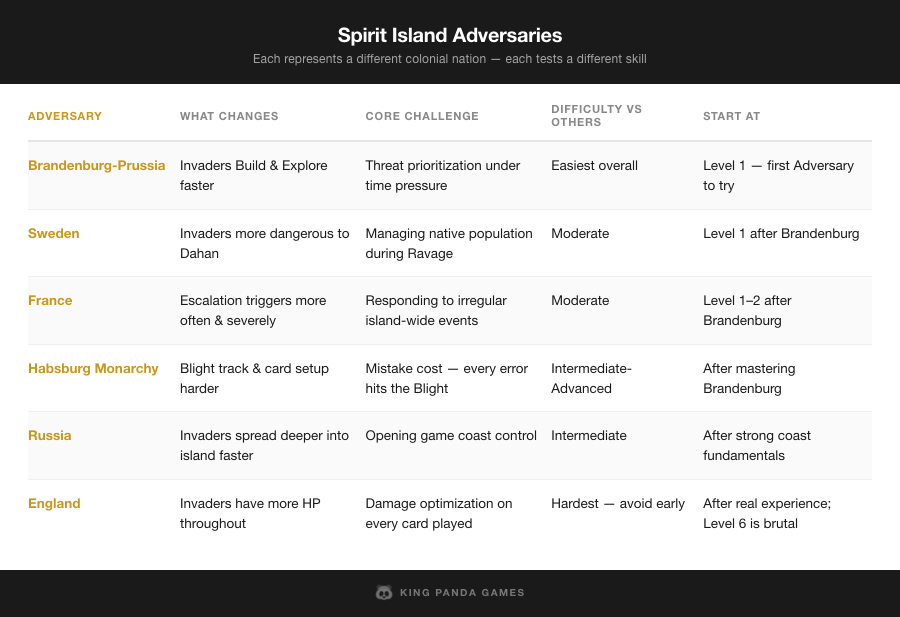
The Adversaries: Who They Are and What They Do
Each Adversary in Spirit Island represents a different colonizing nation, and each changes the rules in a specific thematic way. They each have six difficulty levels (Level 1 through Level 6), with each level adding a new rule or modifier.
Brandenburg-Prussia — Difficulty Levels 1–6
Best first Adversary. Brandenburg-Prussia increases the pace at which Invaders Build and Explore — they expand faster. The rule is straightforward and the effect is direct: the game clock speeds up.
This is the recommended starting Adversary because it tests the one skill new players most need to develop: threat prioritization under pressure. You’re playing the same game, just faster. There are no new special rules to track, no weird exceptions to the Invader Phase. Just more Invaders, sooner.
Start at Level 1 after your Difficulty 0 wins. Brandenburg Level 1 is the gentlest difficulty increase in the game.
England — Difficulty Levels 1–6
The most punishing Adversary. England increases Invader health — Explorers, Towns, and Cities take more damage to destroy. What would have been a clean kill becomes a surviving piece that Builds or Ravages next round.
England fundamentally changes how you evaluate damage values on power cards. A power that deals 2 Damage is clean against a base Town (3 HP); it’s inefficient against an England Town (4 HP). Groups who haven’t optimized for reliable elimination will find their damage “nearly enough” constantly — and in Spirit Island, nearly enough means the Ravage still happens.
England is generally considered the hardest Adversary at equivalent levels. England Level 6 is one of the hardest experiences in the base game. Don’t start here.
Sweden — Difficulty Levels 1–6
Punishes you through the Dahan. Sweden’s rules make Invaders more dangerous to the native people — Dahan take more damage during Ravage, and some Sweden rules give Invaders bonus actions tied to destroying Dahan.
Sweden tests your relationship with the Dahan specifically. Spirits that work with the Dahan (Thunderspeaker especially) change significantly under Sweden’s rules. Spirits that ignore the Dahan are more consistent against Sweden but miss opportunities Sweden creates.
Sweden is a moderate difficulty Adversary overall — harder than Brandenburg at equivalent levels, easier than England.
France — Difficulty Levels 1–6
Tests your Presence management. France accelerates Escalation — the rule that activates when certain Invader cards flip, triggering special island-wide effects. France makes Escalation happen more frequently and more severely.
France is a good intermediate Adversary after you’ve worked through Brandenburg’s early levels. The challenge is less about raw Invader count and more about responding to irregular events — which tests a different kind of flexibility.
Habsburg Monarchy — Difficulty Levels 1–6
Targets your island infrastructure. Habsburg Monarchy’s rules interact with the Blight track and card setup in ways that make Blight management harder. You’re fighting the same Invaders but the cost of any mistake is higher.
Intermediate-to-advanced Adversary. Good for groups who’ve mastered the early Brandenburg levels and want a different kind of pressure.
Russia — Difficulty Levels 1–6
Spreads faster than any other Adversary. Russia’s rules push Explorers and Invaders deeper into the island more aggressively. The coastline fills faster, the interior gets threatened sooner, and the board state deteriorates quickly if you don’t establish control early.
Russia tests your opening game more than almost any other Adversary. Groups who’ve learned coast control well (see our strategy guide) can handle Russia effectively at moderate levels.
How to Calibrate Difficulty for Your Group
| Group profile | Starting recommendation |
|---|---|
| Brand new to Spirit Island | Difficulty 0, no Adversary |
| Lost 2–3 games at Difficulty 0 | Still Difficulty 0 — review strategy fundamentals |
| Won twice at Difficulty 0 | Brandenburg Level 1 |
| Beaten Brandenburg 1–2 | Brandenburg Level 3 or Sweden Level 1 |
| Experienced, want a real challenge | England Level 3+ or any Adversary Level 4+ |
| Veterans looking for the ceiling | England Level 6, or combine two Adversaries |
A useful heuristic: if you’re winning more than 60% of your games at a difficulty level, go up. If you’re losing more than 80%, consider going down one level. Spirit Island is most rewarding at the difficulty where you win about half your games — not where you win all of them.
Combining Adversaries
The rules allow two Adversaries to be combined — each contributing some of their difficulty modifiers. This is strictly for advanced groups. Most base-game combinations sit in the Difficulty 7–10 range, and some combinations interact in ways that are essentially unwinnable for anyone but expert groups — and if you’d rather have new Adversaries and Scenarios than keep stacking the ones you already know, that’s what Jagged Earth adds, and it’s the expansion our ranking puts first.
If you’re considering combining Adversaries, you’ve already played Spirit Island enough to know what you’re doing. The only note: avoid combining two Adversaries whose rules target the same mechanic (e.g., two Adversaries that both modify Ravage damage) — the interactions aren’t always well-balanced and can create more frustrating than challenging experiences.
The Right Difficulty Is the One You’re Currently Challenged By
Spirit Island’s difficulty system exists to keep the game at exactly the right level of challenge for however experienced your group is. There’s no shame in playing Brandenburg Level 1 for ten games while you solidify your strategy. There’s no achievement in playing England Level 6 and losing constantly.
Find the level where winning feels earned and losing feels instructive. That’s where the best Spirit Island games happen.
Check Jagged Earth price on Amazon →
Frequently Asked Questions
Is Spirit Island hard for new players?
Yes, even the base game at Difficulty 0 is a significant challenge for new players, who often lose their first few games. It's designed to be a complex cooperative puzzle where you're constantly learning and adapting, so don't expect easy wins right away.
Where should a new player start with Spirit Island difficulty?
Every new group should absolutely start at Difficulty 0, with no Adversary and no Scenario. This level allows you to learn the core mechanics and your spirit's flow without overwhelming additional rules. Win twice at this level before even thinking about turning up the heat.
What's the best first Adversary for Spirit Island?
Brandenburg-Prussia is hands-down the best first Adversary to tackle after mastering Difficulty 0. It simply speeds up the Invader's expansion, forcing you to prioritize threats under pressure without introducing complex new rules to track.
What's the difference between Scenarios and Adversaries in Spirit Island?
Adversaries represent colonizing nations and directly modify Invader behavior and rules, making the game harder in specific ways. Scenarios, on the other hand, are optional rule variants that twist the *way* you play the game or win, without changing how the Invaders act.
Should I use Scenarios when I'm new to Spirit Island?
Absolutely not, Scenarios are generally not for beginners. They introduce significant gameplay inversions or dramatic difficulty spikes, like Blitz, and should only be considered after you've comfortably beaten several Adversary levels.
Why do I keep losing at Difficulty 0 in Spirit Island?
Losing at Difficulty 0 is completely normal and expected for new Spirit Island players, so don't get discouraged! This base level is still a complex puzzle designed to teach you core threat assessment and spirit synergy, not guarantee a win. Keep practicing to build that foundational intuition before adding modifiers.
Which Spirit Island Adversary makes the game most punishing?
England is widely considered the most punishing Adversary in Spirit Island, and we agree. It drastically increases Invader health, turning what would normally be a clean kill into a surviving threat that continues to ravage or build.